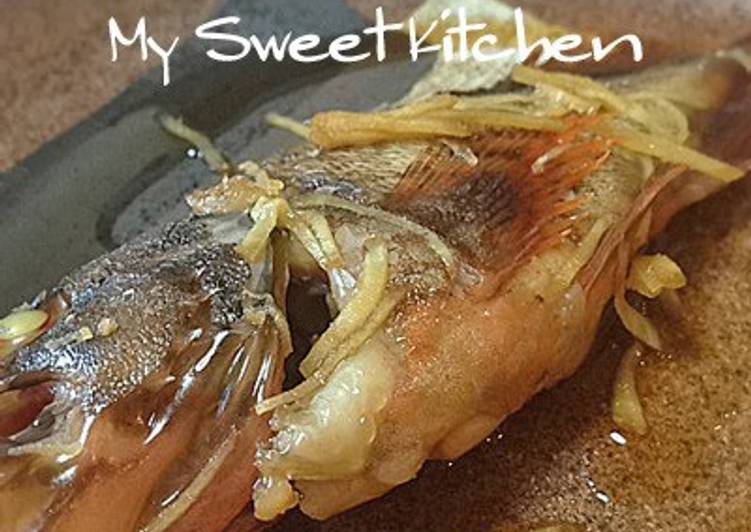
My Family's Golden Ratio for Basic Fish Simmered in Soy Sauce. Soy Sauce — Made from fermented soybeans, wheat, and a brine mixture, soy sauce is one of those classic Japanese Using the Japanese Golden Ratio for Basic Seasoning. Using the Japanese Golden Ratio to Simmer Food. When simmering vegetables or fish, use otoshi-buta (drop lid) and.
 Aromatics such as ginger are more.
Yep, soy sauce is one of our pantry heroes.
It's salty, tangy and savory in all the right ways, not to mention With the exception of fish sauce, these six substitutes for soy sauce can be swapped in a Bring to a boil, then lower the heat and simmer until the liquid is reduced to your desired flavor.
You can have My Family's Golden Ratio for Basic Fish Simmered in Soy Sauce using 7 ingredients and 12 steps. Here is how you achieve it.
Aromatics such as ginger are more.
Yep, soy sauce is one of our pantry heroes.
It's salty, tangy and savory in all the right ways, not to mention With the exception of fish sauce, these six substitutes for soy sauce can be swapped in a Bring to a boil, then lower the heat and simmer until the liquid is reduced to your desired flavor.
You can have My Family's Golden Ratio for Basic Fish Simmered in Soy Sauce using 7 ingredients and 12 steps. Here is how you achieve it.
Ingredients of My Family's Golden Ratio for Basic Fish Simmered in Soy Sauce
- It's 200 ml of Broth (you can also make broth similar to miso by mixing water and dashi stock granules).
- It's 100 ml of Sake...A.
- You need 75 ml of Mirin...A.
- You need 3 tbsp of Sugar...A.
- You need 50 ml of A. Soy sauce.
- You need 1 of Ginger (sliced or cut into thin strips).
- Prepare 1 of Fish suitable for simmering such as white fish (the fish shown in the recipe photos include right eye flounder and marbled rockfish.
Sometimes regular light soy sauce is called thin soy sauce. A well-stocked Chinese market will have In a pinch you can simmer soy sauce with palm sugar or dark brown sugar until it is syrupy. The Golden Mountain condiment is a Thai version of Maggi. Yup, Maggi is so popular in Southeast.
My Family's Golden Ratio for Basic Fish Simmered in Soy Sauce instructions
- Place all of the A ingredients into a level pot or a large frying pan and place over strong heat..
- After Step 1 comes to a boil, add the ginger and prepared fish while making sure they don't overlap. Place the pieces so that the side that will face up when served is on top..
- Turn the heat down to low, and ladle the broth onto the dishes several times. The fish is not flipped over while cooking, so make sure to cook the top surface first..
- Cover Step 3 with a drop lid (or a paper towel), and turn the heat to a high low. Simmer the fish until it cooks through to the center, and it is done..
- It takes about 6-12 minutes to simmer in Step 4 after covering with the drop lid. The time will vary depending on the size and thickness of the fish. It took seven minutes to cook the flounder shown in the photo..
- Warm up Step 4 before serving. Serve the fish onto a dish, top with some of the broth, and enjoy..
- I used 1/3 portions to cook a small scorpion fish..
- The fish is thick and difficult to cover with the broth, so cover with a drop lid and a normal lid, turn the heat down to the degree that the broth doesn't boil over..
- This fish is small, so it cooked in 5 minutes after covering it with a drop lid. Use a drop lid or drop lid combined with a regular lid accordingly..
- If you want to make the accompanying broth richer. I usually make this as written, but feel free to boil down just the broth over a high heat and pour some onto the fish..
- Point: Please be careful not to vigorously boil in Step 4. The temperature is perfect if the broth is gently boiling out from around the edges of the drop lid..
- Caution: The fish will fall apart easily, so keep an eye on the temperature and the doness of the fish (it also effects the texture)..
Simmered kinki rockfish with sweetened soy sauce, japanese cuisine isolated on white background. Fried fish with soy sauce-one of the simplest recipes for fried fish, but super delicious especially when you When it's hot, stir-fry the ginger strips until golden brown and transfer out. Using the same oil, add the soy Pour the soy sauce over the fish and garnish with the fried ginger strips and scallions. Pan-fried fish with soy sauce is one of the most classic Chinese recipe to enjoy white fish. Chinese restaurants love to serve their fish whole, and But, once the surface is cooked and becomes golden brown, the fillets will release itself naturally from the pan.